
Trace Miami Township Previous Residents
Start the search for previous residents with the era of the property record, not with an assumption that one source names everyone who lived there. A deed chain documents parties to ownership transfers. Historic tax lists add annual ownership and value context. Permit files may date work on the property. Directories, census schedules, and obituary citations are household leads only after the address and time period are confirmed. The County’s archives, Recorder, and library each fill a different part of the backward trail.
| Source | Years it covers | Where held | What it can show |
|---|---|---|---|
| Recorder deed records | 1805–present; RISS images documented from 1980 forward | Recorder and RISS | Recorded ownership trail, parties, legal description, and document reference |
| Deed name index | 1805–1928 | Records Center & Archives | Party-name bridge to older deed books |
| Tract or legal-description index | 1805–1986 | Records Center & Archives | Land trail when a street label or number differs |
| Tax and permit groups | Tax lists 1803–1983; permits 1947–2002, cards 1947–64 | Records Center & Archives | Ownership and value chronology, construction or alteration timing |
| Directories, notices, and census | Regional directory serial begins 1856?; HOBITS has listed date bands; census follows federal release | Dayton Room, HOBITS, and library databases | Household or newspaper evidence after geographic coverage is checked |
The earliest source is not always the first to use. Begin with the current parcel, then move backward through each channel until the next older link needs an Archives index or a library collection.
Find Past Miami Township Residents
For a Miami Township address, the current Auditor property record supplies the working key. Save the parcel ID, full situs address, legal description, current tax owner, owner mailing fields, sale or conveyance information, and any deed reference. The current owner or mailing address may be useful property evidence, but neither proves that person occupies the property. The legal description is the field that can persist through address changes and older recording systems.
The County’s Home and Property Research Guide sets out the same starting sequence: current Auditor owner, then legal description, then Recorder grantor-grantee alphabetical or tract-index research.
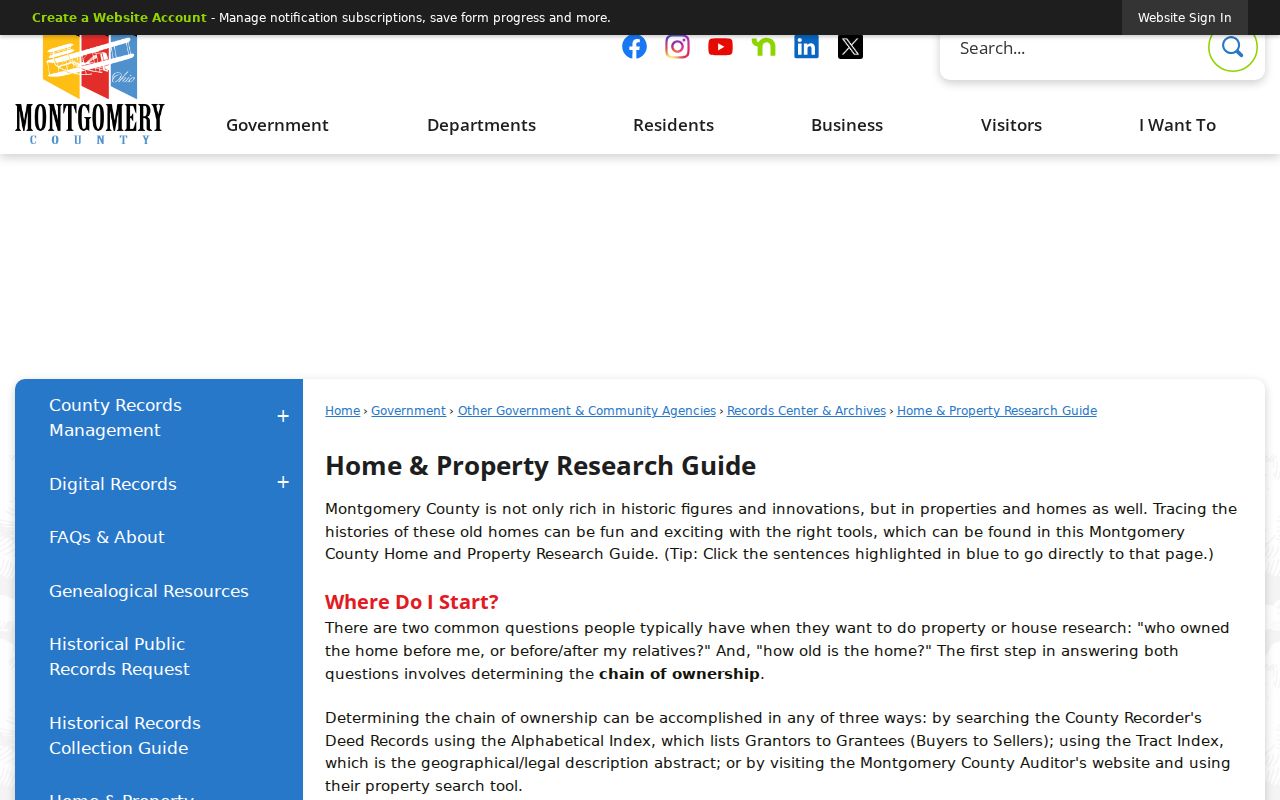
This keeps past-resident research anchored to the property rather than to a name that may belong to another parcel, a mailing contact, or a later event.
Trace Past Miami Township Owners
The Montgomery County deed chain is a backward sequence of recorded transfers. RISS has guest access after its disclaimer and offers name, type, municipality, subdivision, STR, instrument, book/page, fiche, pre-1980, and date routes. Use the current parcel’s legal description and latest conveyance or deed reference to locate the newest deed. Read its grantor, grantee, and legal description, then search the earlier party and the same legal description as the next link. The procedure traces ownership, not an automatic record of every person at the address.
- Open the Auditor parcel and record its parcel ID, legal description, current tax owner, and latest deed or conveyance reference.
- In RISS, choose Deeds and search the current transaction through STR or the relevant party and date fields.
- Read the newest document’s grantor, grantee, file date, file number, and legal description before moving back.
- Search the earlier owner and the same legal description for that party’s acquisition. Repeat each recorded link in reverse date order.
- When the online route reaches an older index or missing image, use the Recorder counter or the Archives’ deed name and tract indexes.
- Grantor
- The party transferring an interest in a recorded deed.
- Grantee
- The party receiving that recorded interest.
- Chain of title
- The linked sequence of recorded land transfers for the same legal property.
- Legal description
- The lot, subdivision, or Section-Town-Range wording that holds the land trail together when an address changes.
RISS for Miami Township Past Residents
Miami Township has a Recorder search quirk worth preserving in the notes. The RISS By Municipality selector did not offer Miami Township during inspection. The STR form, however, lists MIAMI TOWNSHIP in its Properties selection. Choose the required Index Type, then narrow a deed search with Section, Township, Range, a party name, or date where the parcel record supplies it. This is the property-specific route for a Township address, rather than a reason to substitute the City of Miamisburg or a mailing city.
The Recorder’s RISS entry screen leads to the guest index and document-result workflow.
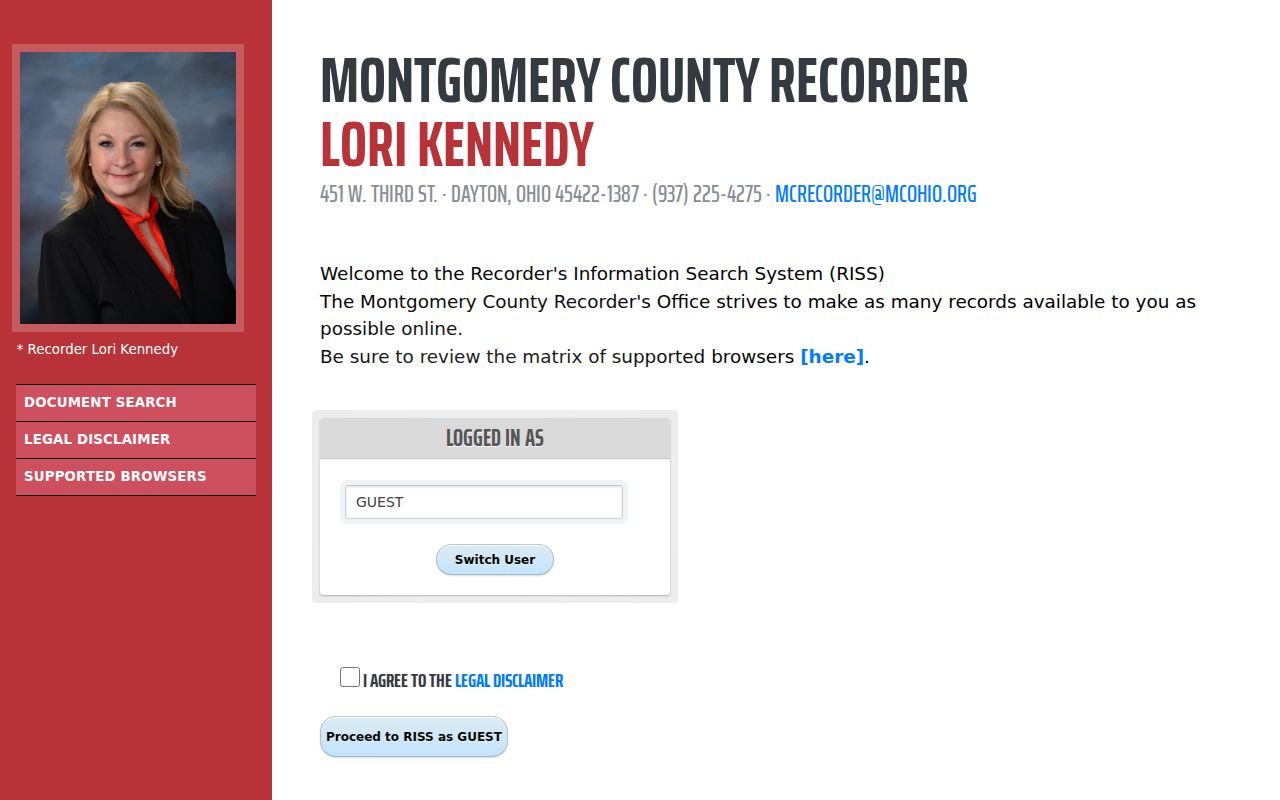
Deeds begin in 1805, while the documented online deed-image route begins from 1980. A record can therefore be real and indexed without a convenient online image.
Miami Township Past Residents and Deeds
Street names and postal labels are useful entry points, but they are weak historic identifiers. Miami Township addresses can use Dayton, Miamisburg, Franklin, Germantown, Moraine, or Springboro postal identities. The City of Miamisburg is within the Township but is a separate city. A legal description, plat, lot, or Section-Town-Range reference connects the same property across those changing labels. The Auditor GIS has Address Number Grid, Historical Lines, recorded plats, annexations, corporation boundaries, and Section-Town-Range layers to help investigate a mismatch.
No authoritative source located a Miami Township-wide street-renumbering or renaming year. Do not assign a date to an address change. Instead, compare the current parcel’s legal description with the Archives tract index and recorded plats, then bring the result back to the deed chain.
Note: A mailing city is a delivery label, while jurisdiction and legal description identify the property record’s actual filing path.
Date Miami Township Property Changes
Historic real-estate tax lists, building-regulation permits, and planning files can date parts of a house history that deeds do not explain. The Archives lists tax records for 1803–1983, permits for 1947–2002, permit cards for 1947–1964, and County planning or zoning case files for 1950–1981. Township zoning began only after a voter-approved local resolution in 1972; earlier zoning was County administered. That custody change matters when a local modern zoning file is silent about an older improvement.
The Montgomery County Treasurer property-tax search is a current public route with tax year, parcel ID, owner name, street number, and street name controls.
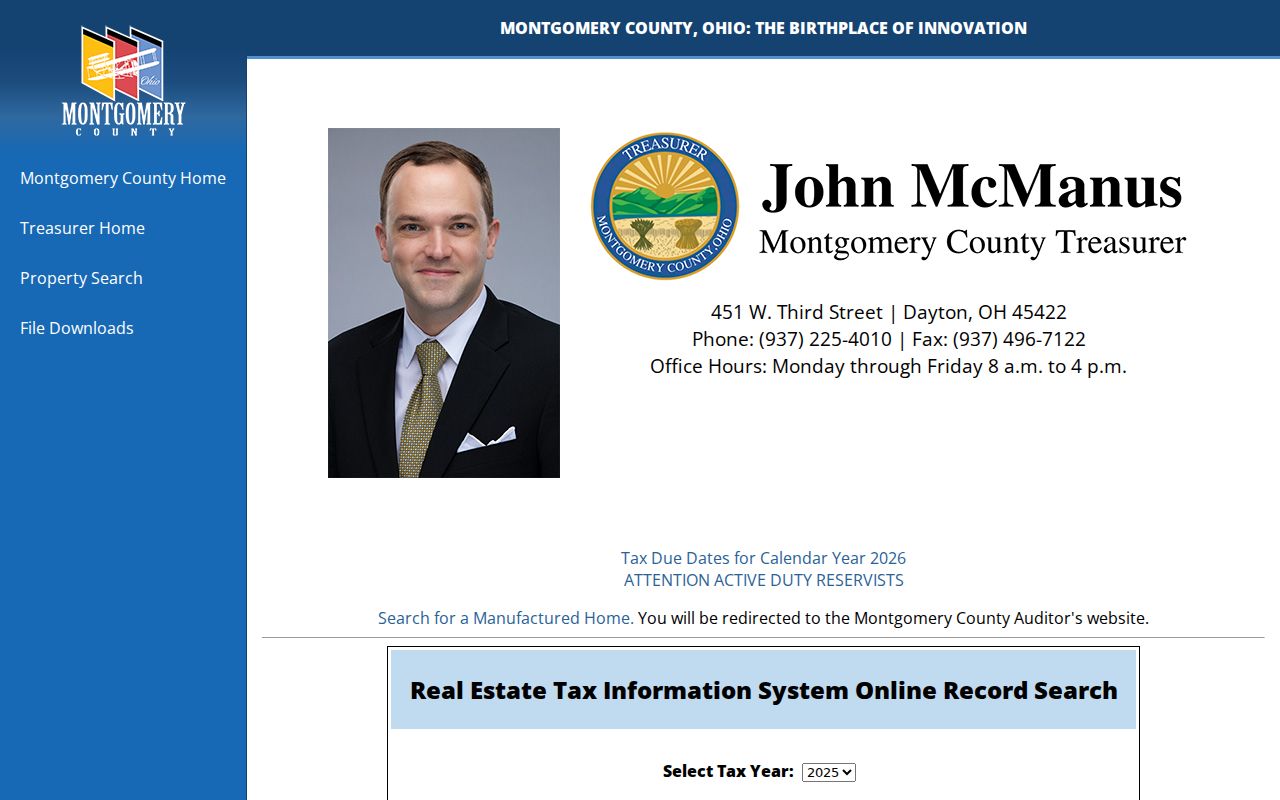
Current or prior tax information can support a property chronology, but it does not replace the Archives series when the question reaches an earlier era.
Pair Miami Township Past Residents
Once a deed or tax record establishes an address and period, the household layer can be tested against a confirmed directory volume and the closest released federal census. The Dayton Room is the regional starting point for local history, directories, newspapers, maps, and genealogy material. Williams’ Dayton City Directory is a cataloged serial beginning “1856?–,” while a 1958 Miamisburg City Directory citation exists in an Ohio History Connection bibliography. Neither item establishes complete Township coverage. Check the edition and address geography before treating an entry as a lead.
- Record the exact address form, surname spelling, and year from the verified land record.
- Ask the Dayton Room whether a directory or reverse-address volume covers that geography and edition.
- Preserve each printed abbreviation rather than expanding it by guesswork, then compare the next available volume for an address or spelling variant.
- Pair the directory year with the closest released federal census and compare household details, not just a matching name.
- Use the matching time period to check tax, probate, obituary, and deed evidence before drawing a conclusion about past residents.
Collections and reading conventions belong with the Miami Township city directory collections; their use here is limited to confirming a household stage in one address trail.
Marriage Leads for Past Miami Township Residents
Marriage and death evidence can distinguish similarly named adults after a property and household era have been established. Montgomery County Probate has a public marriage index with an online cutoff from 2001; older material belongs with court or Archives routes. Certified marriage copies follow the County’s listed request options. HOBITS is a separate Dayton newspaper-obituary and genealogy citation index with specific date bands. Its results are citations, not the full article, and the library asks for complete citation details when requesting a copy.
The Montgomery County Probate marriage index shows the party-and-date search route.
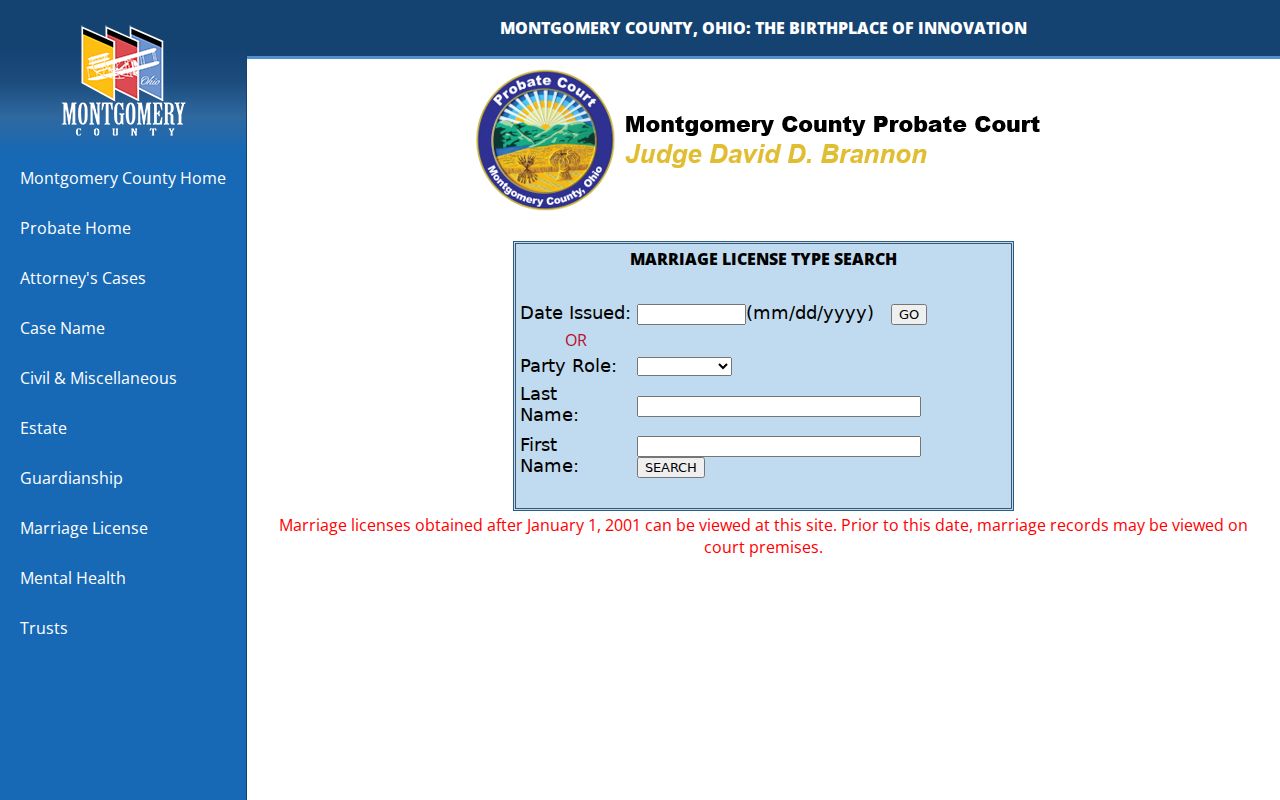
A match can be a family-history lead, not proof that either party occupied the property. Compare the event date and place to the address trail.
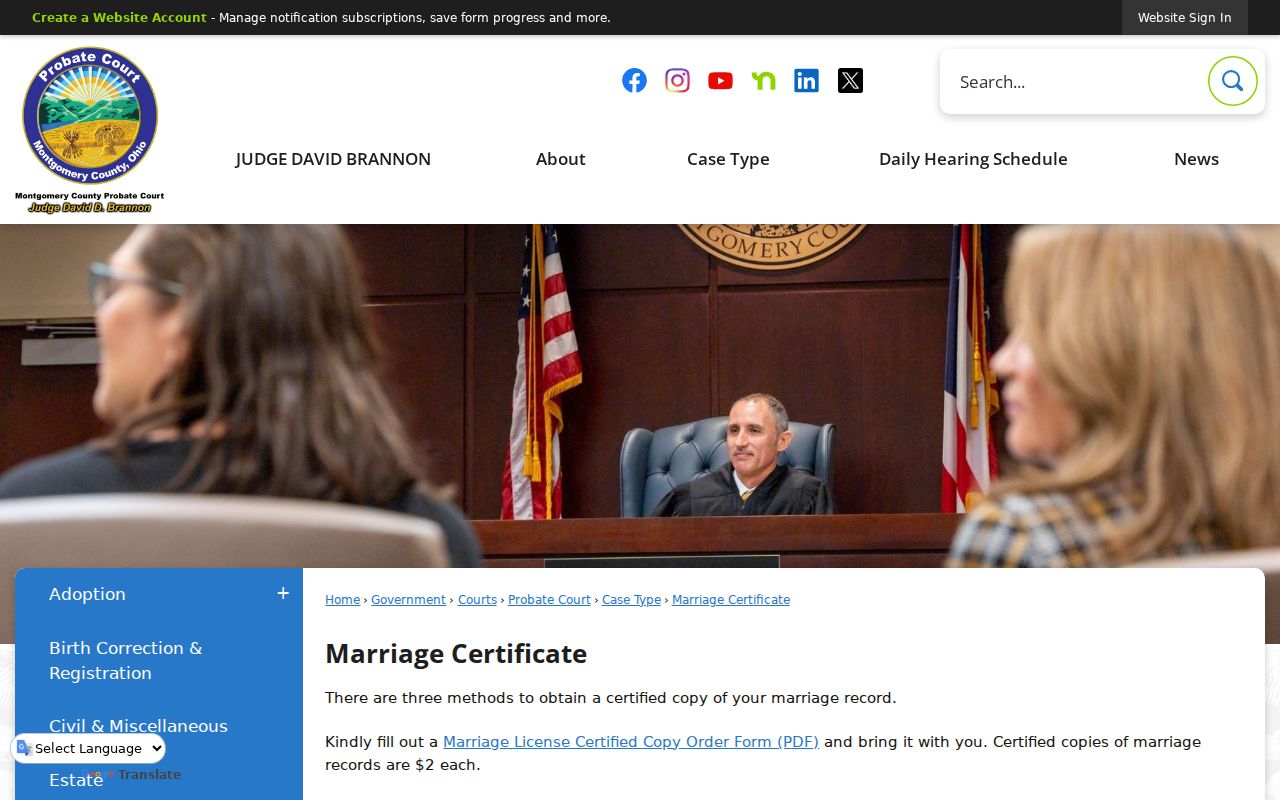
The Montgomery County marriage-certificate information describes the certified-copy request path.
For an estate relationship, use Probate files and historical will or estate indexes, then verify the person through the property dates instead of relying on an event record by itself.
Map Earlier Miami Township Addresses
Maps and imagery can explain a property’s physical setting even when the prior-resident chain stops. County Engineer GIS offers historical imagery from 1938 forward, surveys, right-of-way plans, and section-corner recovery records. Dayton Metro Library has Sanborn resources for Ohio cities from 1882–1962, but no particular Miamisburg or Township sheet and year was verified. The Miamisburg Historical Society offers local census records, maps, photographs, documents, and a digital catalog that can be checked before a visit.
These resources supply context about lots, improvements, roads, and neighborhoods. They should not be used to invent a household connection where no directory, census, deed, tax, probate, or citation record supports one.
Lawful Miami Township House History
Previous-resident research is best used for family history, estate and heir questions, a property’s documentary history, or checking a suspected deed problem. The public record has deliberate limits. Safe at Home and Shielding Ohio Protectors can suppress information from voter data and some other records. Court material can be sealed or redacted. The County does not publish a universal resident roll, and a tax owner, mailing contact, or past deed party is not a claim about a current household.
Lawful use. Use Miami Township house-history records for personal, lawful research and verify them with the responsible custodian. R.C. 2903.211 addresses stalking conduct that causes fear or mental distress; never use a past-resident trail to stalk, harass, or harm a person.
If a deed notification appears suspicious, the Recorder’s free Fraud Alert Notification can supply an instrument number for RISS review. It alerts a registered owner after recording and does not prevent a filing, so contact the Recorder promptly about a questionable document.