
Miami Township Resident Record Coverage
A Miami Township resident lookup is a cross-check, not a single search. An Auditor result may establish a tax owner, a mailing field, or the physical parcel tied to a name. A voter result can confirm registration details for one person. Court and probate indexes can show that a party name appeared in a proceeding. Vital and historical sources can supply an event lead. None of those findings, alone, proves who currently lives in a household. Keep the question narrow and preserve the record type behind every match.
| Record | What it confirms | Where | Access |
|---|---|---|---|
| Auditor parcel roll | Tax owner, parcel link, situs and owner mailing fields | Montgomery County Auditor | Free read-only owner, address, and parcel searches |
| Recorder RISS | Party role and legal-property connection in a recorded document | Recorder RISS | Guest search; older work can require the Recorder or Archives |
| Voter lookup | Individual registration, precinct, and polling location | Ohio Voter Lookup | First name, last name, and county; protected data are withheld |
| Court or probate index | Case party or estate-case name | Montgomery County PRO and Probate | Some material is redacted, sealed, restricted, or at the counter |
| Vital or historical index | Event or newspaper-citation lead | PHDMC, Ohio History Connection, HOBITS, or Archives | Index and certified-copy routes have different rules |
| State filing or credential record | Entity association or credential status | Ohio business search or eLicense | Association fact, not a home-address claim |
When a name is all that is known, begin with the Auditor owner search in Last First form and use a wildcard only where the portal permits it. Read the parcel’s legal description, situs, and mailing fields separately. If a deed reference matters, compare its party and legal-description details in RISS. The Miami Township street directory is the better route when the question shifts from one person to a whole street.
Verify a Miami Township Resident
Names repeat, and Miami Township records can carry several city or postal labels. Capture the full spelling, former surname or alias, date range, party role, parcel legal description, and the township, city, or postal geography shown in each result. A matching surname at a different mailing address does not settle identity. Property ownership is also not an occupant roster. That distinction is the key local caution when using a resident lookup.
- Use the Auditor’s owner search to find a candidate parcel, then note its owner, situs, mailing address, and legal description without treating any one field as a residence claim.
- Use a relevant conveyance reference in RISS to compare recorded parties and the legal-property link. For civic confirmation, run the person’s name through Ohio Voter Lookup with Montgomery County selected.
- Narrow same-name voter results with the offered street choice. Add a court case date or type only as a separate corroborating fact, because court dockets can lag or omit material.
- For a family-history event or a copy needed for an estate matter, use the responsible vital or probate custodian rather than assuming a search screen is the official record.
R.C. 149.43 supplies Ohio’s public-records framework, but the right custodian depends on the record. The Auditor handles parcel facts, the Recorder handles recorded-document issues, the Board of Elections handles voter data, the Clerk and Probate Court handle their files, and PHDMC handles its vital-copy procedure.
- Docket
- A court’s running case record, usually listing filings, events, and scheduled activity rather than proving every document is public online.
- Index and image
- An index is a searchable entry that points to a record. An image is the scanned document itself, when the custodian makes it available.
- Certified copy
- A copy issued and authenticated by the custodian for an official purpose. It is different from a search result or an informational image.
- Legal description
- The lot, subdivision, or section-township-range description that connects a parcel to recorded land documents more reliably than a casual street label.
Miami Township Court Record Checks
Montgomery County Public Records Online is the wider county court search. Its General Search has Case Number, Last Name, First Name, Company Name, Ticket Number, Case Type, Action Type, Begin Date, and End Date fields. Use a name plus a date range or case type when possible. PRO covers Montgomery County Municipal Court traffic, criminal, and civil cases, Common Pleas General Division matters, Domestic Relations, and Second District Court of Appeals cases.
| PRO field | How the official form uses it |
|---|---|
| Case Number | Looks for a known case directly. |
| Last Name and First Name | Party-name route for a person search. |
| Company Name or Ticket Number | Alternatives when the party or ticket detail is known. |
| Case Type and Action Type | Filters the court classification and action category. |
| Begin Date and End Date | Limits a broad result set by time. |
PRO returns no more than 1,000 records, so narrowing is essential. Documents normally appear 48 to 72 hours after filing, and confidentiality can mean a document is redacted or absent. The displayed docket is not authenticated. Certified copies require an in-person Clerk request; the Clerk says redacted civil, criminal, domestic-relations, and appellate documents can still be viewed in the office even when online material is unavailable.
Montgomery County Probate Court Case Search information identifies Probate as a separate search route.
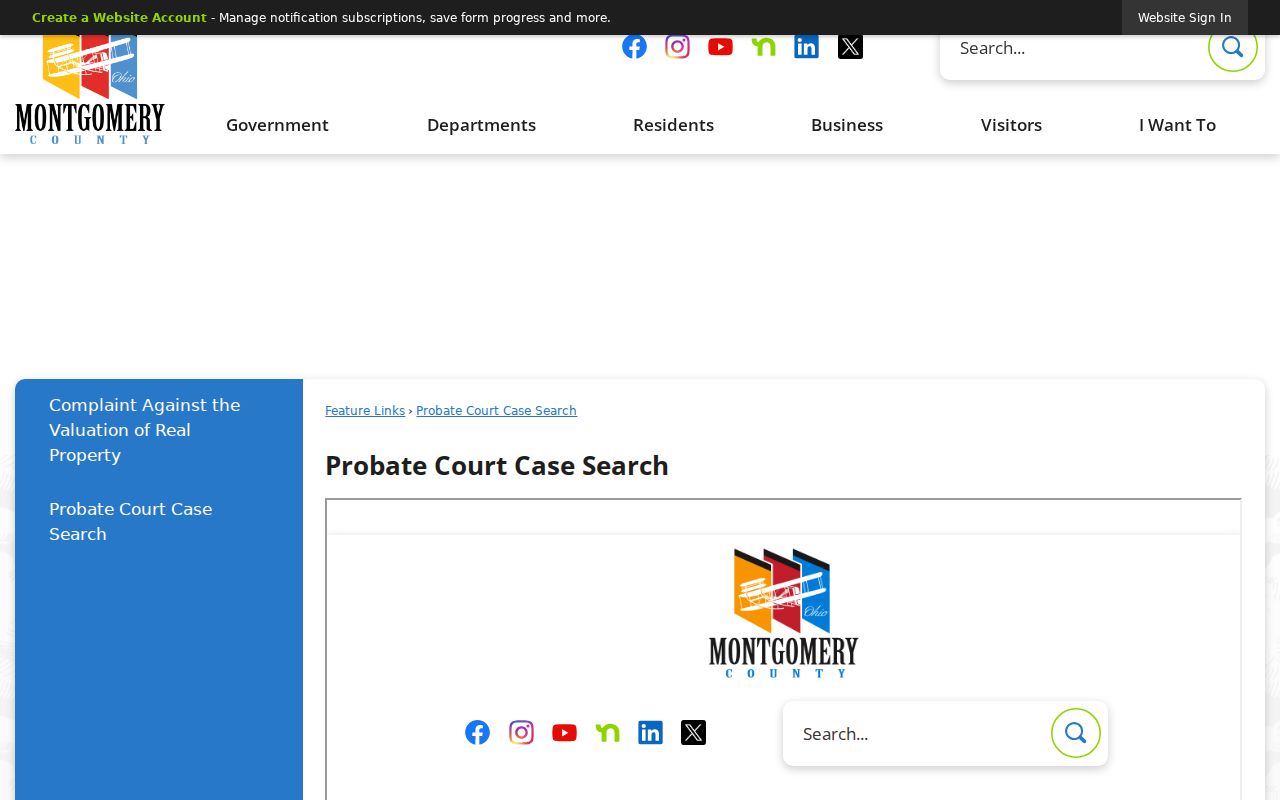
The image is a reminder that county court and Probate routes are separate, so the record type should choose the office.
Miami Township CaseLook Checks
Miamisburg Municipal Court serves Miami Township as well as Miamisburg, Germantown, West Carrollton, and German Township. CaseLook is the online convenience route, but its disclaimer says records may be delayed by at least 24 hours and may change. The session agreement prevented safe inspection of the search form, so no unverified field list belongs in a Miami Township resident lookup.
For a verified copy or a search-procedure question, use the clerk at Miamisburg Municipal Court rather than drawing a conclusion from a delayed display. The court’s local rules describe public civil, small-claims, felony, misdemeanor, and traffic dockets, but a listed case category is not evidence of a current address or household connection.
Miamisburg Municipal Court CaseLook presents its agreement and delay notice before a session.
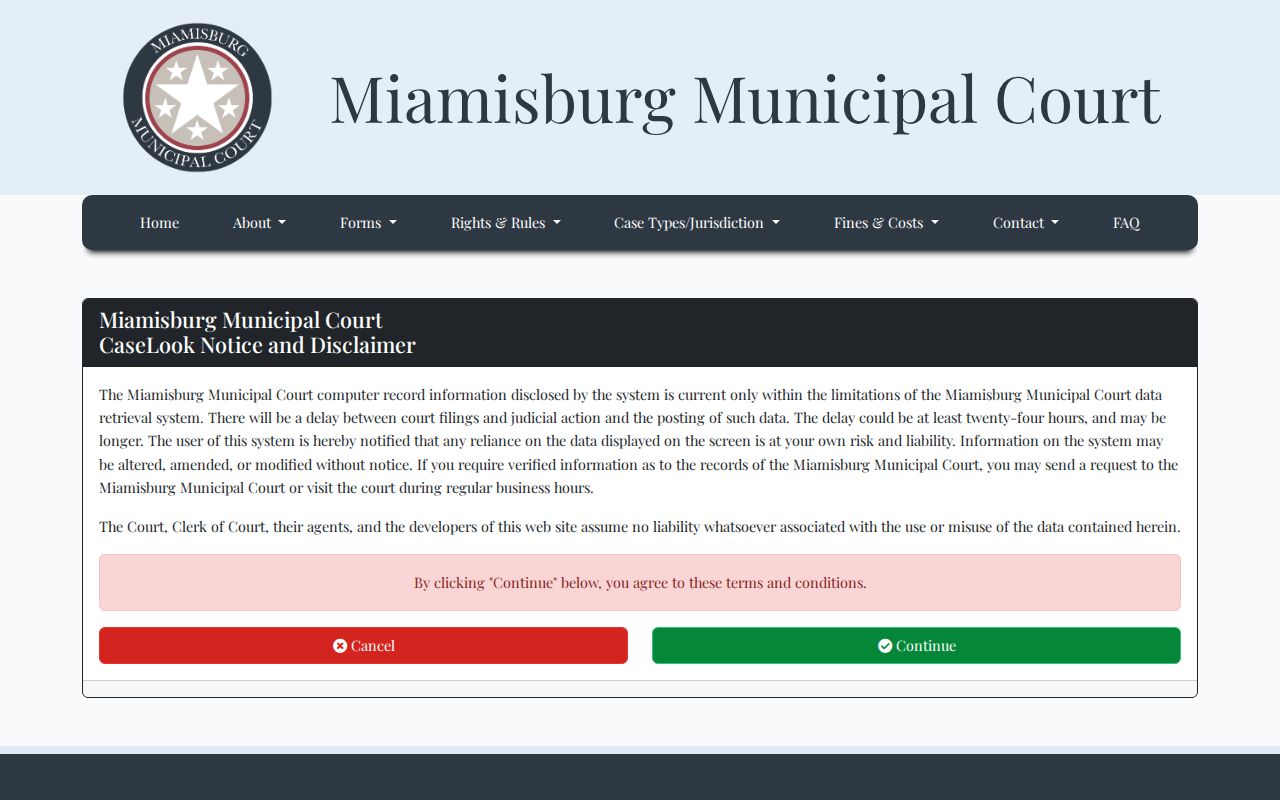
The timing warning makes the clerk fallback important when a dated, complete, or authenticated record is needed.
Note: A local court screen can be useful for a party-name lead, but the clerk remains the route for verified copies and unavailable online material.
Miami Township Probate Estate Trails
Probate is the useful channel when the question concerns an estate, guardianship, marriage, name change, or a potential heir relationship. Its estate search accepts Last Name and First Name, and it publishes distinct estate, guardianship, miscellaneous, and marriage routes. Most Probate cases are public subject to court rules and individual restrictions, while adoptions and mental-health cases are restricted. Marriage licenses after January 1, 2001 can be viewed online; earlier marriage records are viewed at the court.
The Probate estate-search result screen shows the limited index inventory captured during research.
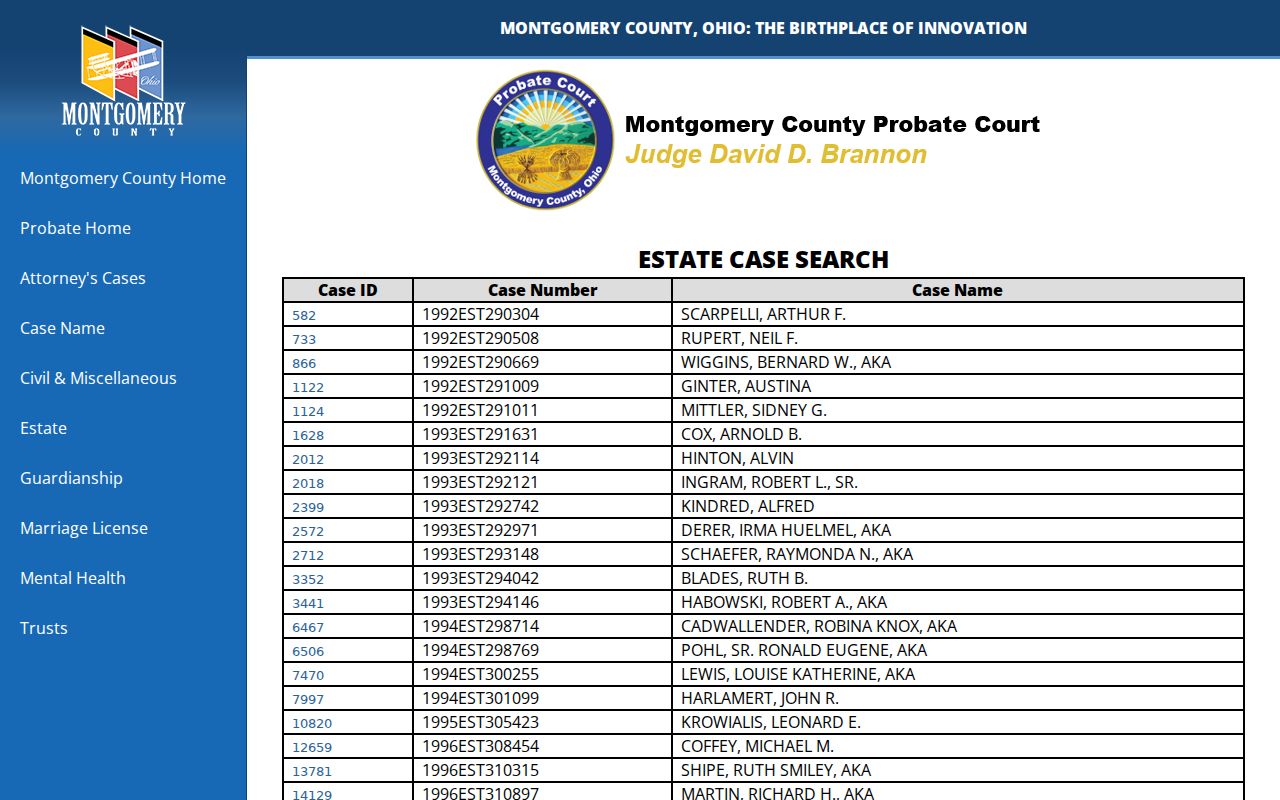
Use the result to identify a case, then ask Probate about file access or copy details rather than assuming the index includes a full docket or document set.
| Probate index field | What it supplies |
|---|---|
| Case ID | The index’s internal case identifier. |
| Case Number | The court case reference to retain for a follow-up. |
| Case Name | The name carried by the estate index entry. |
Marriage research has a separate party or date search. Certified marriage copies are available in person or by mail for $2 each, while the online route has its own listed transaction and delivery charges. Probate records can support an estate relationship, but they do not replace the cross-checks needed for a resident lookup.
Miami Township Vital Record Paths
Public Health, Dayton & Montgomery County is the local certified-copy channel. It provides Ohio birth records from 1908 forward and death-certificate service for Ohio deaths from 1909 forward, with an agency caution to call before assuming statewide handling for an individual death. The certified-copy form covers birth, death, and fetal-death certificates and lists a $23 fee per certified copy.
For a mail request, PHDMC accepts its form or a letter with the child’s name, birth date and county, the mother’s full maiden name, and the father’s full name if shown. Mail payment is by certified check or money order. In person, the listed payment options include cash, certified check or money order, and card. PHDMC lists processing after registration as seven to ten business days. Historical routes differ: Montgomery County material for 1867 through 1908 is directed to historic sources, and pre-1909 deaths are outside Ohio’s standard vital-record system.
The Ohio History Connection death index is an historical lead, not a certified-copy issuer. It searches listed death collections with first name, last name, county, date-range, and Soundex controls. A certificate or record number can help refine a later custodian request.
Confirm a Miami Township Voter Result
Ohio Voter Lookup is a narrow individual confirmation tool. It requires first name, last name, and county, then offers a street-name choice when multiple matches need separating. It reports registration, precinct, and polling-location information without asking for date of birth. Test a familiar-name variant, former surname, or previous Ohio address if an expected result is missing, then refer a true nonmatch to the county board.
Ohio law makes some voter information public while withholding Social Security and ID numbers, phone and email information, Safe at Home details, and protected addresses. Precinct registration lists may be inspected at the Board of Elections, and names and addresses may be copied only in the office during open hours. The State DATA portal is a different channel: it publishes daily county voter-registration snapshots, retains them for at least 22 months, and limits custom date ranges to seven days. Preserve the snapshot date and county when comparing results over time.
Miami Township State Record Scope
Some official searches have a defined scope rather than a Township-wide people list. Ohio Department of Rehabilitation and Correction Offender Search is a state custody and supervision locator. It can provide a separate official record trail where its scope fits the question, but it does not establish a person’s present Miami Township address.
The ODRC Offender Search interface shows the state locator’s search controls and scope notice.
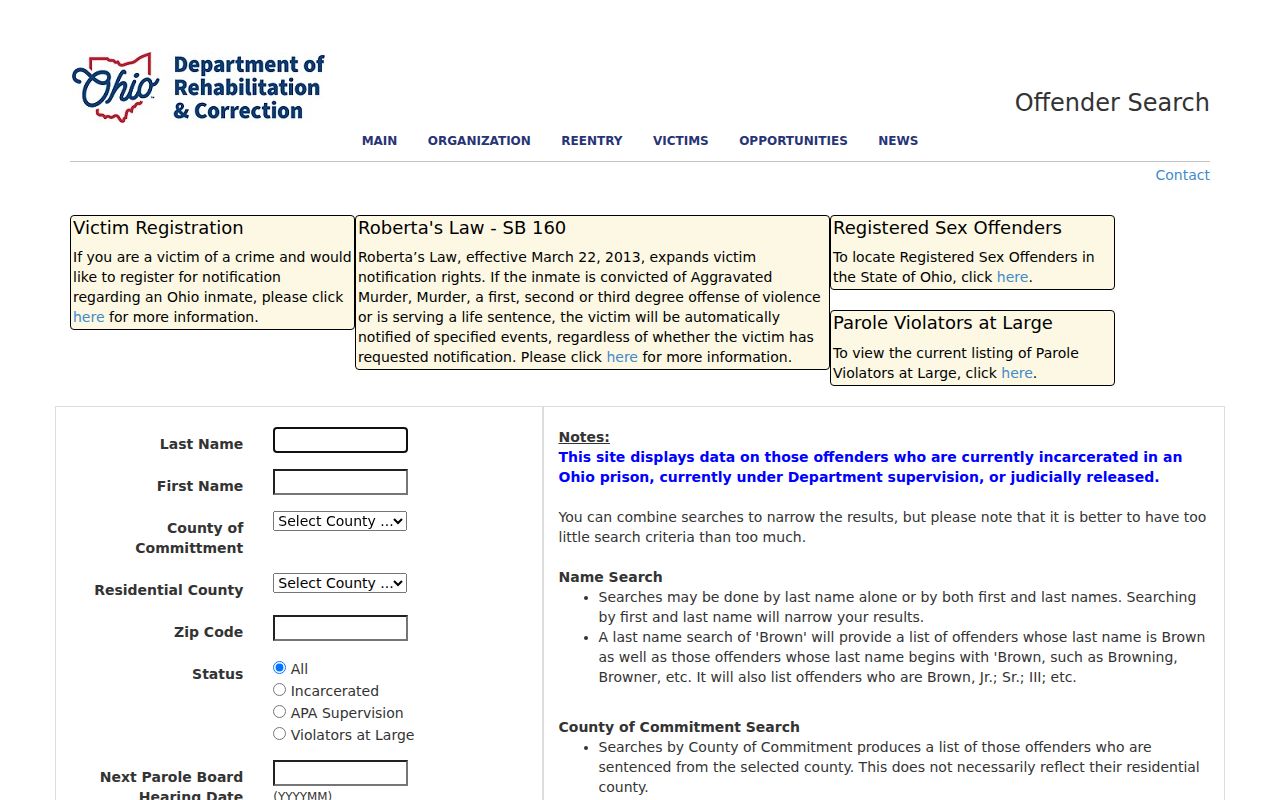
Keep its result separate from property, voter, probate, or court evidence and verify any needed record with the responsible agency.
Miami Township Resident Record Limits
Ohio Safe at Home gives qualifying survivors and household members a substitute-address route through a certified Application Assistant. The program protects address, phone, and related identifiers in public records, including voter registration. Shielding Ohio Protectors is a separate redaction path for eligible designated workers and some former workers. Neither program means every older record disappears automatically.
R.C. 149.45 requires online records to redact, encrypt, or truncate Social Security numbers. A redaction request should identify the record and field, and the office must act or explain impracticability within five business days. Route a parcel or ownership issue to the Auditor, recorded-document material to the Recorder, voter information to the Board of Elections, and court-display issues to the Clerk or court. A Township request cannot require a county or state custodian to change its database.
Lawful personal use. Use a Miami Township resident lookup only for a legitimate personal or records purpose. Do not use an address or record detail to stalk, harass, intimidate, or harm anyone.
Note: Where an office cites a redaction exception or practical barrier, retain the written response and follow the custodian’s official remedy channel.